Commissioning a Sigil
Whether this is for you, or for someone you wish to give it to, every commission begins in the same place.
Within the Archive.
Sometimes a single engraving remains quietly with us long after we have left it.
Sometimes several begin to gather together.
When that happens, a Gathering has begun.
Individually, each engraving carries its own recognition. Brought together, something else can appear.
You know the story. Only you know what they mean together.
Your Gathering
A single engraving may be enough.
Or recognitions may begin to gather.
Two, four or six engravings can be brought together within your commission.
Single Crest
£75
One engraving. One recognition, held on its own.
Printed in black with its orientation line beneath. A short personal inscription may be added if you wish.
Two Crests.
£110
Two engravings that have begun to belong together.
The relationship between them is yours. Their orientation lines accompany the work on a separate archival card.
Four Crests
£145
Four engravings, each recognised on its own.
Gathered together, connections may appear that were not visible before. Their orientation lines accompany the work on a separate archival card.
Six Crests
£180
Six engravings, recognised separately and gathered together.
Each remains distinct, but their relationship becomes part of the whole. Their orientation lines accompany the work on a separate archival card.
Prepared in the Studio
What you recognise, we prepare.
Every commission is prepared individually at A3.
Each engraving is restored by hand from its original historical source and printed on Hahnemühle German Etching 310gsm paper.
Nothing is generated.
Nothing is embellished.
Your inscription
Your inscription doesn't explain your commission.
It belongs to it.
A name, a date, a place, a few words, or something understood only by you.
1974 / Festive Road / Not Guilty
Palettes
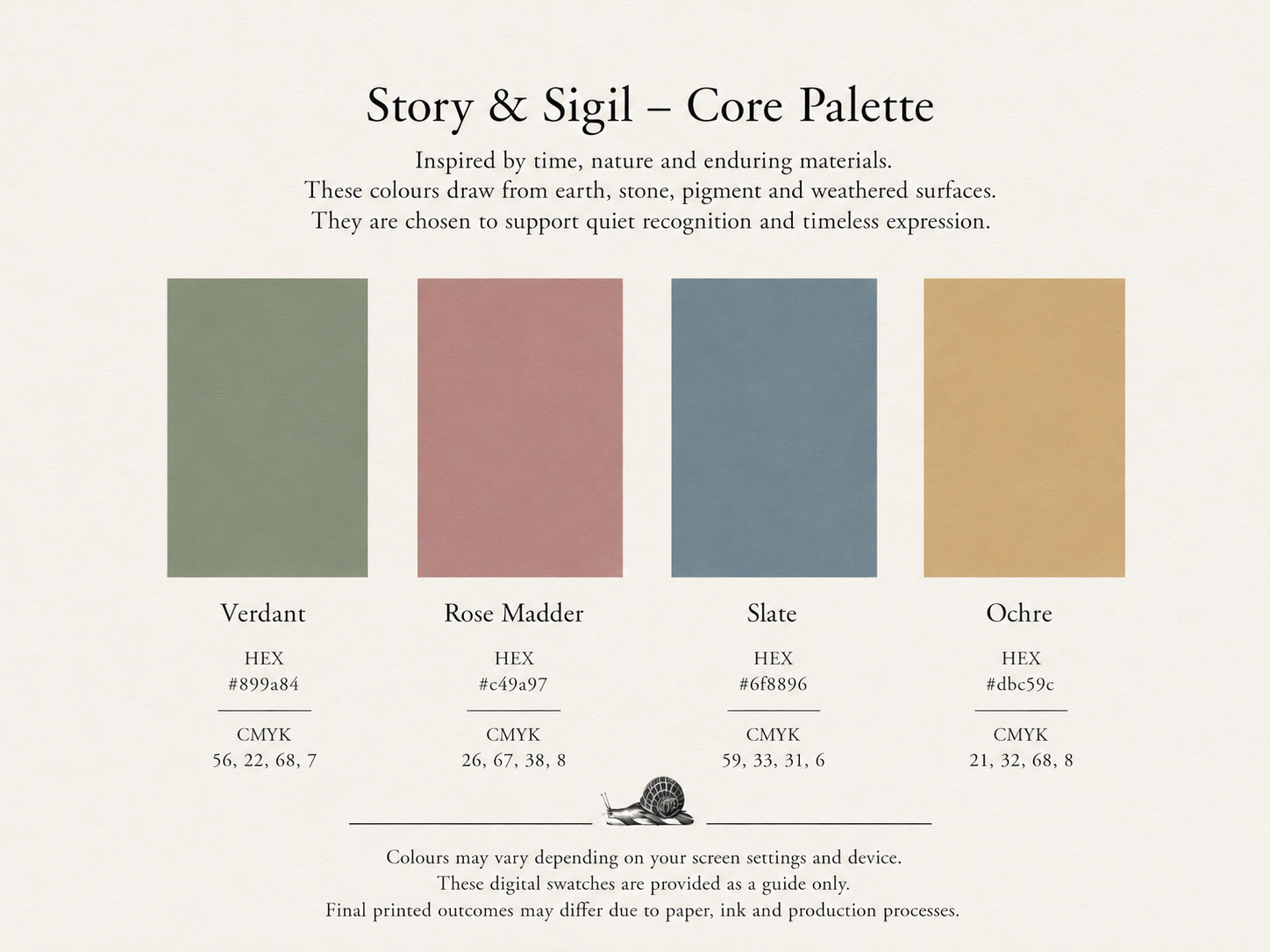
From two crests onwards, a palette may be chosen for your Gathering.
Verdant. Rose Madder. Slate. Ochre.
Colour changes the atmosphere surrounding the engravings.
The engravings themselves remain unchanged.
Giving a Commission
Gift Commission
From £100
A Story & Sigil commission can be given to someone else.
We send a physical invitation on your behalf, together with your personal message, inviting them to enter the Archive in their own time.
What they recognise there belongs entirely to them. A single engraving may stay with them, or several may become their Gathering.
What they recognise, we prepare as their commission.
Thank you for spending some time here.
You are welcome simply to look. Not every recognition needs to become a commission.
You may leave with something, or simply leave having felt something.
The Archive remains.